BrainStorm vs Obsidian: Your Second Brain Files. It Does Not Answer.



Head to Head (Without the Marketing Sweep)
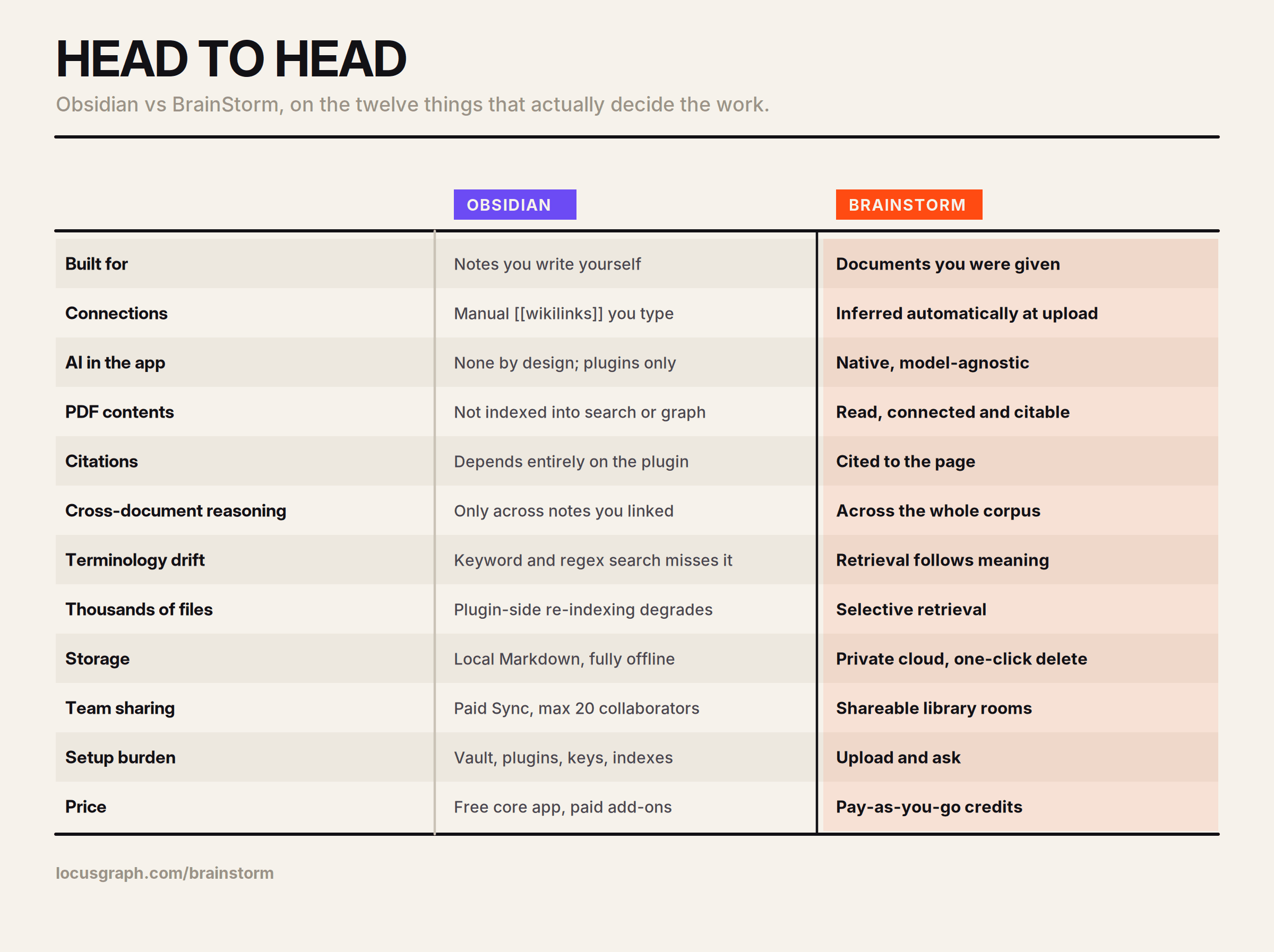
Obsidian still wins on offline local privacy by architecture, zero lock-in (plain Markdown), a free core, long-form composition and Canvas, and unmatched extensibility. If your primary job is composing your own thinking on your own disk, stay in Obsidian. That is a good decision.
Switch pressure rises when most of these are true: more documents given than notes written; questions that start with why did we or what did they say; citations you can put in front of someone else; vault reorganizations more than twice this year; “I’ll just search for it” attempts over ten minutes; the same files re-uploaded to a chat tool more than five times.
BrainStorm: The Software Connects. You Think.
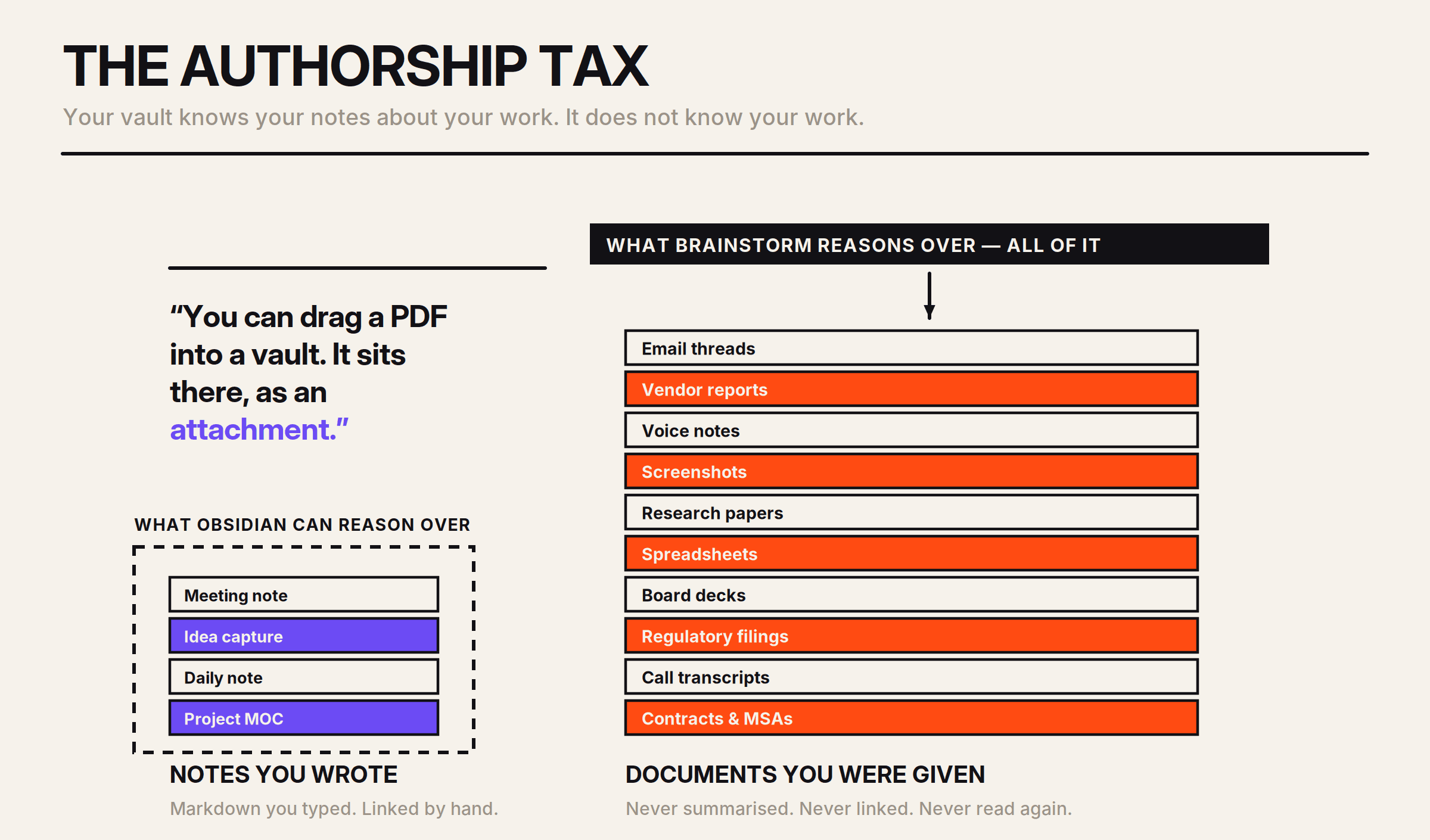
BrainStorm is a knowledge base you can brainstorm with. You upload documents, notes, conversations, and decisions once, including source material you did not author. Research, analyze, brainstorm, and draft from that base without maintaining the graph by hand or rebuilding the packet every session.
Powered by LocusGraph, related material connects so each question retrieves relevant context. Files stay your intellectual property, stay private under your control, and are never used to train public AI models. Delete when you need to. Pricing is pay-as-you-go with free credits on signup.
Obsidian remains the best place to write your own thinking offline. BrainStorm is for the corpus you were given: connect it once, ask across it, and check the citations.
If you want that workflow: Get Started (registration code: brainstorm2024), or Book a Demo.
Your vault is a card catalog you maintain by hand. The only real question is how much longer you want the job of being the librarian.
What’s the biggest limit of Obsidian for document-heavy work?
It mainly knows what you typed and linked. PDF attachments often sit outside search, backlinks, and the graph, so the vault knows your notes about the work, not the work itself.
Does BrainStorm replace Obsidian?
For document-heavy research and decision work, it can cover that job. For long-form personal writing and offline local notes, many people will sensibly keep writing in Obsidian and reason over source material in BrainStorm.
Can Obsidian do AI?
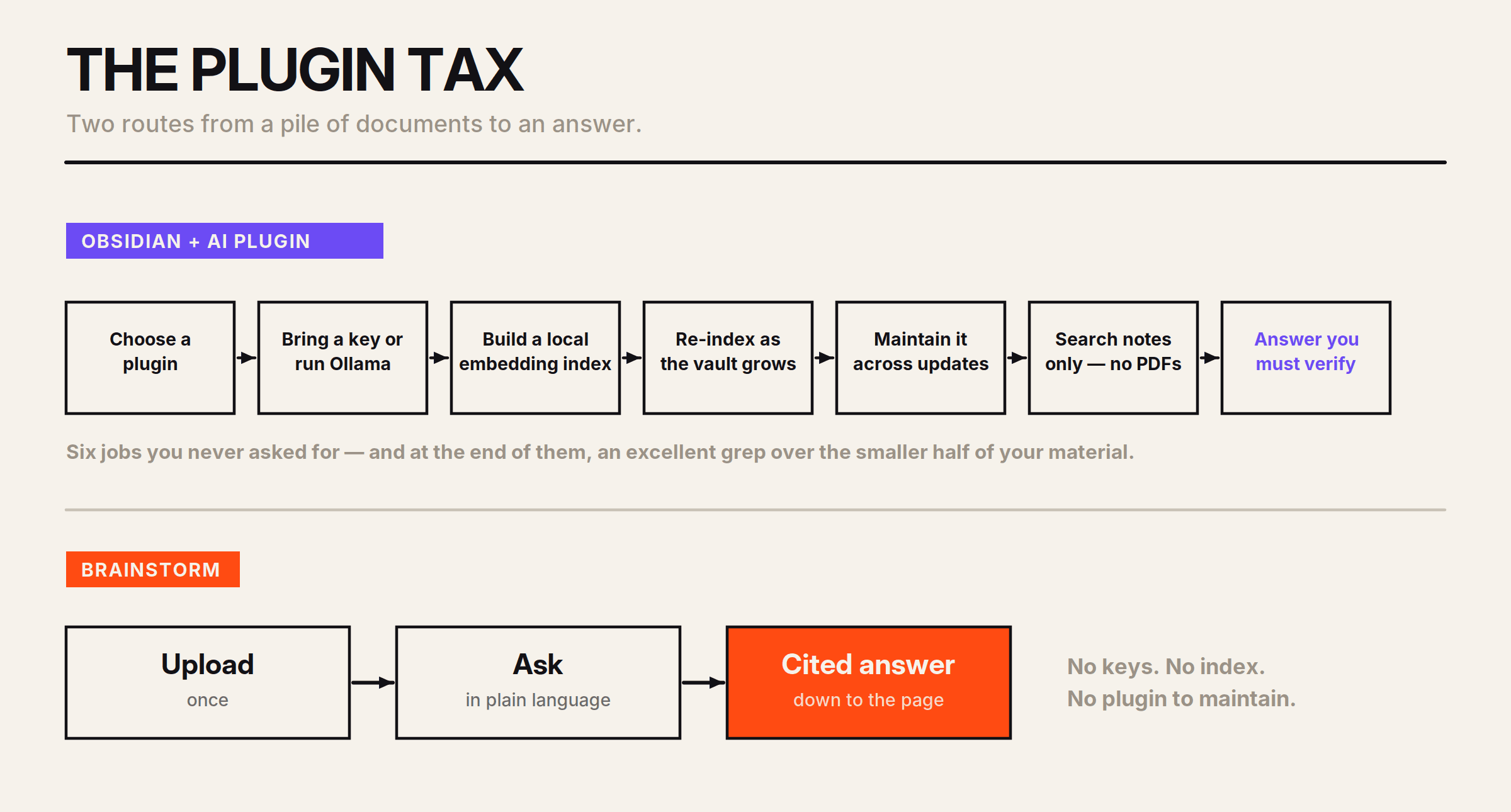
Through community plugins, yes. There is no AI in the core app by design. Plugin stacks mean you choose and maintain models, keys, and indexes, and you often still reason only over notes you authored.
What is the linking tax?
Every connection is a manual wiki-style link you type by hand. The graph reflects your discipline, not automatic relationships across contracts, transcripts, and reviews you never linked.
Will better folders fix a vault that can’t answer?
Usually no. Questions arrive unlabeled. Filing solves storage; the real failure is reachability under time pressure across material you did not author.
How does BrainStorm keep documents private?
Files remain your intellectual property, stay private under your control, are never used to train public AI models, and can be deleted when you need to.
How does BrainStorm help with this?
BrainStorm is a knowledge base you can brainstorm with. Upload the documents you were given once; LocusGraph connects related material and retrieves relevant context so you ask across the corpus instead of maintaining the graph by hand.
Not just longer-context. Not just better-prompted.