Why AI Can't Find Information You Know Exists
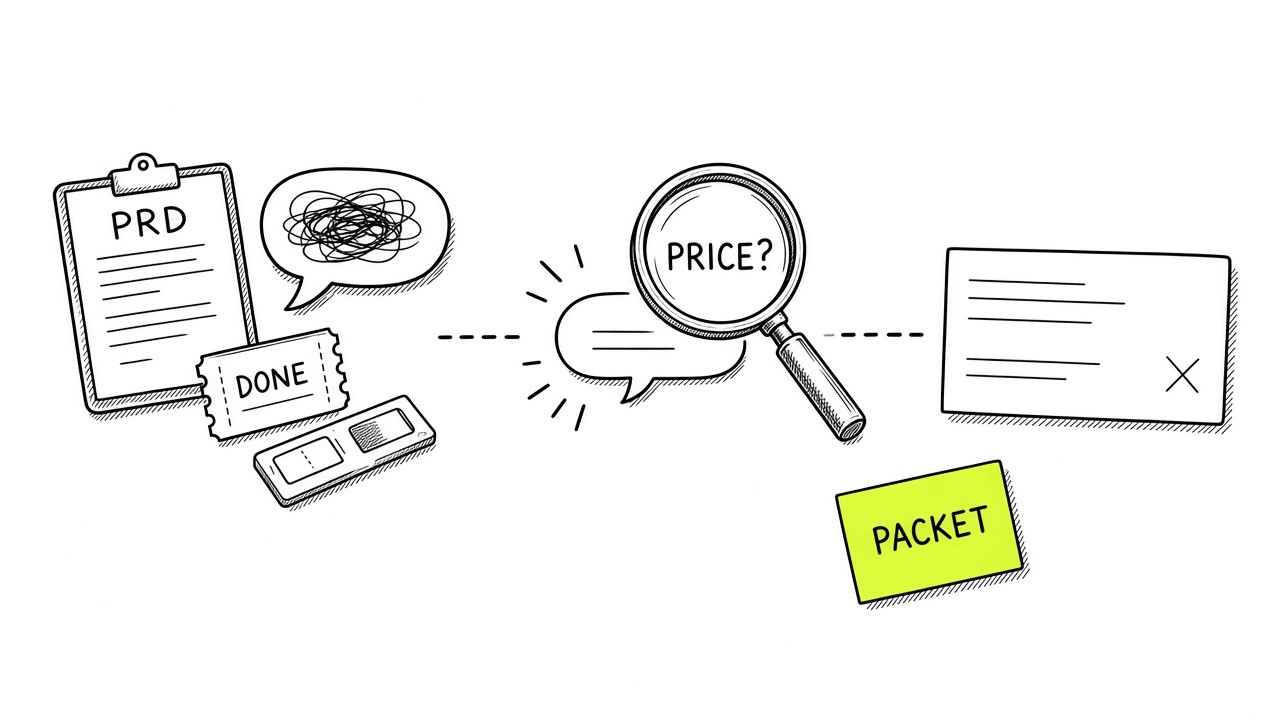
Connected Context Is the Real Requirement
Stop asking: where should we dump the files so AI can see them?
Start asking: can the next teammate (or the model) reuse the reasoning without rebuilding the packet from Slack archaeology?
For startup and product teams, that means:
Keep related artifacts linked when a decision lands: call note, PRD section, Slack thread, ticket, deck slide.
Capture the why with the what: options considered, evidence that mattered, what got rejected.
Prefer one working set over five chat uploads: the same customer and product context should survive across weeks, not reset every Monday.
Treat repeated questions as a scoreboard: if the team keeps asking “what did we decide about X?” the knowledge is not AI-ready.
Three tests:
Retrieval: Can AI answer a question you already know is documented without you pasting the packet again?
Continuity: Do later sessions still see last month’s product decisions without a full re-upload ritual?
Connection: Can you see how the answer links back to the call, the PRD, and the rejected alternative?
Fail those and you have folders full of startup work. Pass them and prior work compounds.
Where Known Answers Stay Askable
Once you accept that the job is connected context, not another place to store PDFs, the product fit is clearer.
BrainStorm fits when the pain is “I know this decision exists; the AI still cannot find it.” Upload the PRDs, call notes, Slack exports, tickets, and decks that already hold the week’s work. Ask the next product question against connected context instead of restaging the archaeology in a fresh chat. LocusGraph retrieves related discussion, evidence, and outcomes together, so the answer is not a lonely file with the story missing.
The win is not a prettier Notion sidebar. The win is fewer third explanations of a decision you already made.
If you want to try that workflow: Get Started (registration code: brainstorm2024), or Book a Demo.
The most expensive sentence a growing product team can keep saying is simple: I know we have that somewhere.
AI can't find information you know exists when the company saved files and lost the connections between them. Connected knowledge is how that sentence gets rare.
Why can't AI find information I know exists in our company?
Because the answer often lives as separate files and threads with no shared spine. The model sees fragments, not the decision packet.
Is a better prompt enough to fix AI retrieval failures?
No. Prompts help when context is already in the window. They do not rebuild a pricing or product decision split across Slack, Notion, Linear, and Drive.
Doesn't connecting more tools solve this?
Connecting tools increases the pile. It does not guarantee current versions, related artifacts, or the rejected alternatives that explain the call.
How is this different from "I can't find the file"?
Human findability is one failure. AI retrieval failure is another: you know it exists, search may surface hits, and the model still cannot return a connected answer.
What should product teams capture when a decision lands?
The trigger, options, evidence, constraint, and rejected paths, linked to the call note, PRD section, Slack thread, ticket, and deck slide.
How do you know knowledge is AI-ready?
Retrieval, continuity, and connection: AI can answer without a paste ritual; later sessions keep prior decisions; answers link back to evidence.
How does BrainStorm help when AI can't find known information?
BrainStorm keeps PRDs, notes, threads, tickets, and decks in one workspace so the next question can ask against connected context. LocusGraph retrieves related discussion, evidence, and outcomes together.
Not just longer-context. Not just better-prompted.