BrainStorm vs ChatGPT: It Remembers You. It Doesn't Remember Your Documents.




Head to Head (Without the Marketing Sweep)
ChatGPT (Plus / Pro) | BrainStorm | |
|---|---|---|
Built for | Conversation, drafting, agentic tasks | Cumulative work over a document corpus |
Uploaded corpus | Low tens of files per project (connected apps separate) | Hundreds of files in one workspace |
Which files get used | Ones you pre-selected or connected | Relevant slice per question |
Continuity | Strong on you and recent chat context | Strong on your material, decisions, and sources |
Connections between documents | Not inferred as a default graph | Connected at upload |
Citations in everyday ask | Limited / mode-dependent | Cited answers with source grounding |
Web research | Excellent | Not the focus |
Models | OpenAI models | Claude, GPT, more over time |
Price | Subscription per seat | Pay-as-you-go credits; free credits to start |
ChatGPT still wins on conversation, open-web Deep Research, platform breadth, team ubiquity, and simple seat pricing. If your work does not involve a large body of source documents you did not write, you do not need BrainStorm. Do not buy infrastructure for a problem you do not have.
Switch pressure rises when most of these are true: more documents given than notes written; questions that start with why did we or what did they say; citations you can put in front of someone else; file limits or split projects; pre-sorting attachments before you know what matters; a corpus measured in hundreds, not dozens.
The Knowledge Base Is the Container
OpenAI bet that the conversation is the right container for working with AI, then spent years making that container better: bigger memory, persistent projects, better search, longer runs. Every one of those releases is a concession that the session was too small, and each one makes it a little bigger.
BrainStorm makes a different bet: the knowledge base is the container, and the conversation is how you talk to it.
BrainStorm is a knowledge base you can brainstorm with. You upload documents, notes, conversations, and decisions once. Research, analyze, brainstorm, and draft from that base without rebuilding the same packet every session.
Powered by LocusGraph, related material connects so each question retrieves relevant context instead of stuffing every file into every chat. Files stay your intellectual property, stay private under your control, and are never used to train public AI models. Pricing is pay-as-you-go with free credits on signup.
ChatGPT remains the best place to think out loud. BrainStorm is for the filing cabinet that has to grow with the work: the corpus, the decision thread, and answers you can check.
If you want that workflow: Get Started (registration code: brainstorm2024), or Book a Demo.
You do not need a smarter colleague on their first day, every day. You need a workspace that was still here last quarter.
Is BrainStorm a ChatGPT replacement?
No. ChatGPT remains strong for conversation, drafting, and open-web research. BrainStorm is for cumulative work over a large document corpus with answers you can check.
How many files can you upload to ChatGPT Projects?
Per OpenAI’s Projects documentation, roughly five on Free, about twenty-five on Plus tiers, and around forty on top plans. Connected Drive or Slack can widen reach, but that is not the same as one connected corpus.
Does ChatGPT memory fix the restart tax?
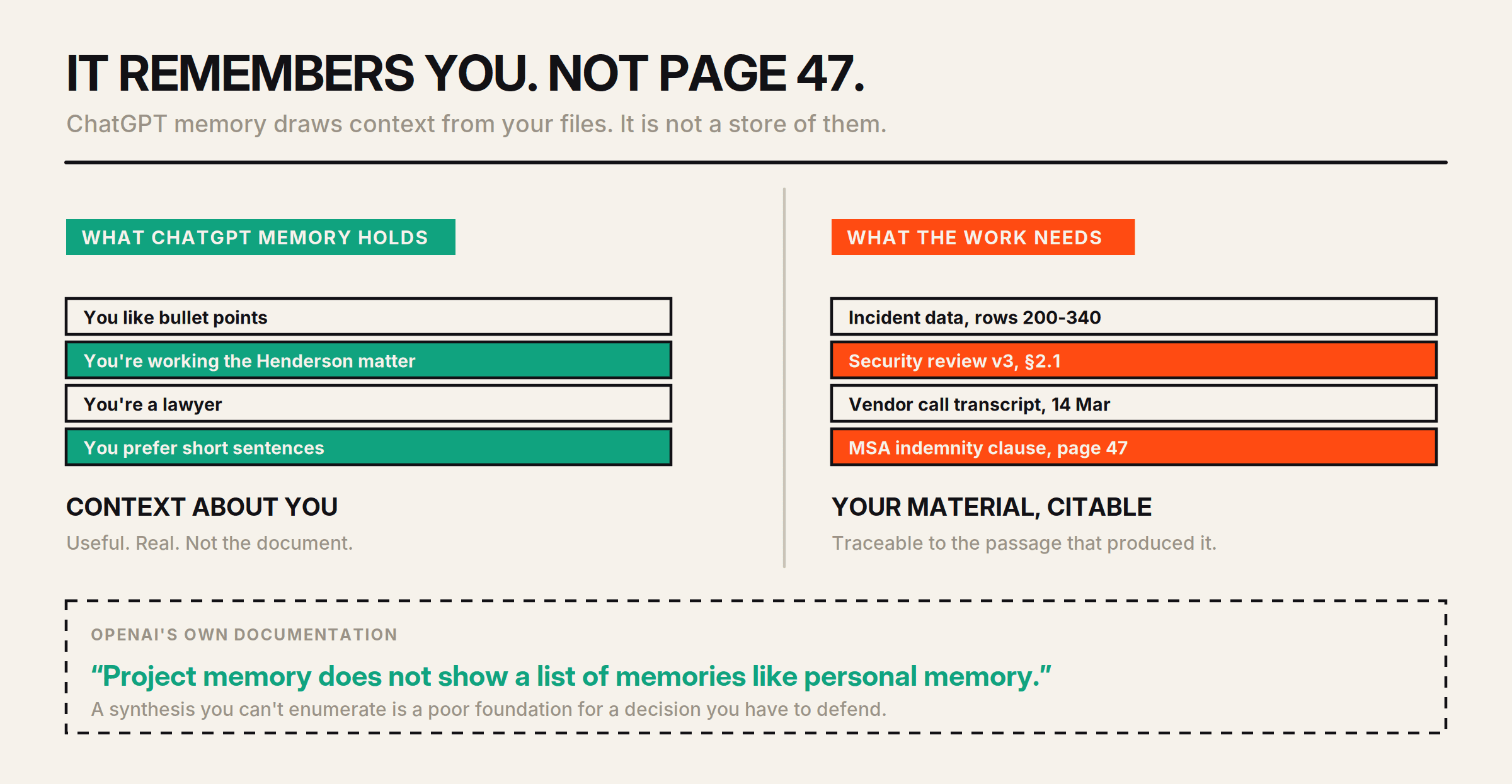
Personalization helps with preferences and prior chat context about you. It does not replace a durable store of the working set, decision thread, and argument trail across source documents.
Does ChatGPT cite uploaded documents in everyday chat?
Deep Research and some business features cite sources. Everyday Project chat often still leaves you verifying a fluent synthesis by reopening the files yourself.
When should someone stay on ChatGPT alone?
When the work does not involve a large body of source documents they did not write, and conversation or open-web research is the main job.
How does BrainStorm handle hundreds of files?
You upload once into a knowledge base. Powered by LocusGraph, each question retrieves relevant connected context instead of stuffing every file into every chat.
How does BrainStorm help with this?
BrainStorm is a knowledge base you can brainstorm with. Upload documents, notes, conversations, and decisions once; later sessions continue from the corpus instead of rebuilding a chat attachment set.
Not just longer-context. Not just better-prompted.